


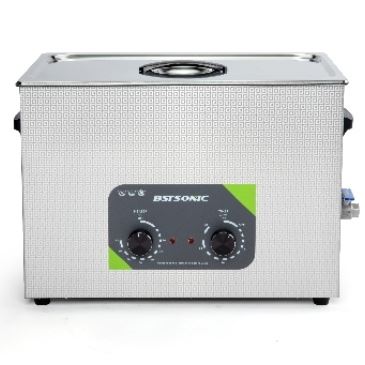


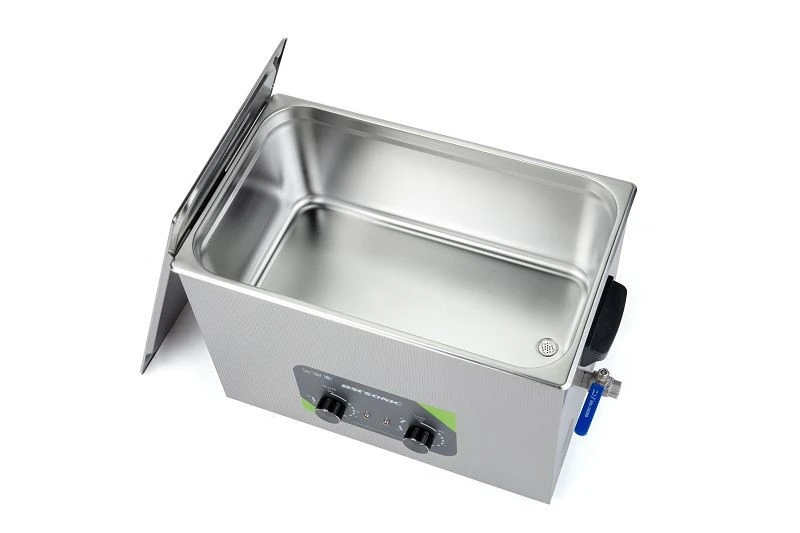

The BS1027A – 27L Ultrasonic Cleaner is built for heavy-duty industrial cleaning. It's particularly ideal for electronic circuit boards, which demand delicate yet thorough cleaning. The ultrasonic waves penetrate the narrowest gaps, removing solder flux, dust, oxidation, and microscopic debris – all without risking damage to delicate components.
Beyond electronics, it's also ideal for automotive parts (cylinder heads, injectors, carburetors), manufacturing equipment, medical tools, and even 3D printing components. The ultrasonic cleaning process is based on cavitation – high-frequency sound waves generate microscopic bubbles that implode upon contact with surfaces, lifting dirt, oil, and contaminants effectively and safely.
Applications – Where the 27L Ultrasonic Cleaner Shines
- Circuit boards, PCBs, connections, and soldered joints are used in the electronics industry.
- Automobile Repair: brake parts, gearboxes, injectors, and cylinder heads
- Cleaning precise instruments and assemblies in mechanical engineering and aerospace
- Flasks, tubes, and other delicate scientific equipment
- Manufacturing Facilities: Metal components, dies, moulds, and tools
- Orthodontic implements and non-porous surgical equipment in medical and dental clinics
- Jewellery and watchmaking: Deep cleaning and restoration of complex metal objects
Built to Endure – Quality Meets Performance
The stamped stainless steel 304 tank of the BS1027A has no weld seams, lowering the possibility of corrosion and leaks. Even with demanding daily use, the industrial-strength body and transducers are designed for reliable cleaning performance. This cleaner is designed to keep up in a busy repair shop or on a production line.
Key Features
- 27L Stamped SUS304 Stainless Steel Tank – Durable and corrosion-resistant, seamless design
- Digital Control Panel – Precise time (1–99 minutes) and temperature (20–80°C) adjustment
- Industrial-Grade Ceramic Transducers – Delivering powerful and consistent ultrasonic waves
- Temperature-Safe Lid with ABS Handle – Ergonomic and heat-resistant
- Cooling Fan and Heat Dissipation – Helps prolong machine life during long usage
- Powerful Heating System – Aluminum heating plate ensures quick and even heat distribution
- Adjustable Ultrasonic Frequency – 28kHz for heavy-duty degreasing, 40kHz for gentle detailing
- Accessories Included – Comes with stainless steel basket, lid, and power cable
- Grounded & ESD-Protected Housing – Anti-static metal construction for electronics safety
Specifications – BS1027A
|
Name |
Ultrasonic cleaner |
Model |
BS1027A |
|
Tank capacity |
27L |
Ultrasonic Power |
600W |
|
Ultrasonic Frequency |
28 or 40KHz |
Time setting |
1-20minutes |
|
Temperature range |
20-80 ℃ |
Internal tank size |
500×300×200mm |
|
External dimensions |
550×330×380mm |
1pc Gross weight(kgs) |
16.3kgs |
|
Packing size for 1pc |
660×440×470mm |
Carrying handles |
✓ |
|
Drain outlet |
✓ |
Lid/Basket |
✓ |

Can Ultrasonic Cleaners Safely Clean Electronic Circuits?
Yes, when used properly, ultrasonic cleaners can safely clean PCBs and electrical components.
Selecting the proper frequency, cleaning solution, temperature, and cleaning duration is crucial.
Cavitation is the process by which ultrasonic cleaning produces tiny bubbles. These bubbles quickly burst, clearing the board's surface of oxidation, oil, flux, and dirt-even in places that brushes are unable to reach.
Because of this, ultrasonic cleaning is perfect for:
- Circuit boards that are printed (PCB)
- SMT assemblies
- Connectors for electronics
- Switches and relays
- Metal-based contacts
- Accurate electronic components
But not every electronic component needs to be cleaned in the same manner.
Microphones, speakers, some sensors, MEMS devices, and some crystal oscillators are examples of sensitive components that can need extra care or should be taken out before cleaning.
The objective is controlled and safe cleaning, not just stronger cleaning.
Looking for a different capacity?
We have a large selection of ultrasonic cleaners to suit every use case, ranging from small desktop models like 1.3L or 3L to larger machines like 15L, 27L, and beyond. For clients in the USA, EU, UK, India, South Africa, and Japan, we offer plug types and voltages that are specific to each region. Allow us to assist you in choosing the ideal cleaner for your requirements.
Electronic Circuit Board Cleaning Result Comparison

This test demonstrates how oxidation and flux residues can be eliminated from electronic circuit boards using ultrasonic cleaning without causing component damage.
How Ultrasonic Cleaning Works
High-frequency sound waves are used in ultrasonic cleaning to create tiny bubbles in the cleaning solution. These bubbles forcefully burst (a process known as cavitation), cleaning all surfaces, including those that are invisible to the human eye. Without scratching or harming the object, this non-contact cleaning technique efficiently eliminates oxidation, dirt, grease, carbon buildup, and more.
After cleaning, all you need to do is rinse and dry the parts, and your items will be practically brand-new in terms of both appearance and functionality.
Manual Cleaning vs Ultrasonic Cleaning
| Method | Manual Cleaning | Ultrasonic Cleaning |
|---|---|---|
| Time | Long | Short |
| PCB Safety | Risky | Controlled |
| Small Gaps | Hard | Easy |
| Consistency | Low | High |
Benefits of Ultrasonic Cleaning
- Fast and Efficient – Minutes for deep cleaning
- Safe for Delicate Electronics – No chance of static damage or abrasion
- Eco-Friendly – Requires very little water and detergent.
- Thorough – Removes blind holes, complex assemblies, and internal passageways.
- Versatile – Works with glass, ceramics, metals, plastics, and more.
- Cost-Effective – Minimises the need for labour, chemicals, and repeated cleaning
Warranty and Support
- 24-Month Warranty – During the warranty period, we will replace any unit that cannot be repaired.
- Bonus Spare Parts – Included with your first machine order
- Rapid Customer Support – Response within 1 hour during business hours
- Lifetime Technical Assistance – Ongoing assistance with troubleshooting and usage direction
Every member of our sales team has sold ultrasonic cleaners for at least seven years. They can quickly offer expert guidance to help you improve customer service and boost your ability to compete.
FAQ – 27L Ultrasonic Cleaner Electronic Circuit
Hot Tags: ultrasonic cleaner electronic circuit, China ultrasonic cleaner electronic circuit manufacturers, suppliers, factory, Ultrasonic CAPA Cleaner, sunglasses ultrasonic cleaner, ultrasonic fuel injector cleaner, analog ultrasonic cleaner, Ultrasonic Cleaner Sunglasses, ultrasonic harmonica cleaner